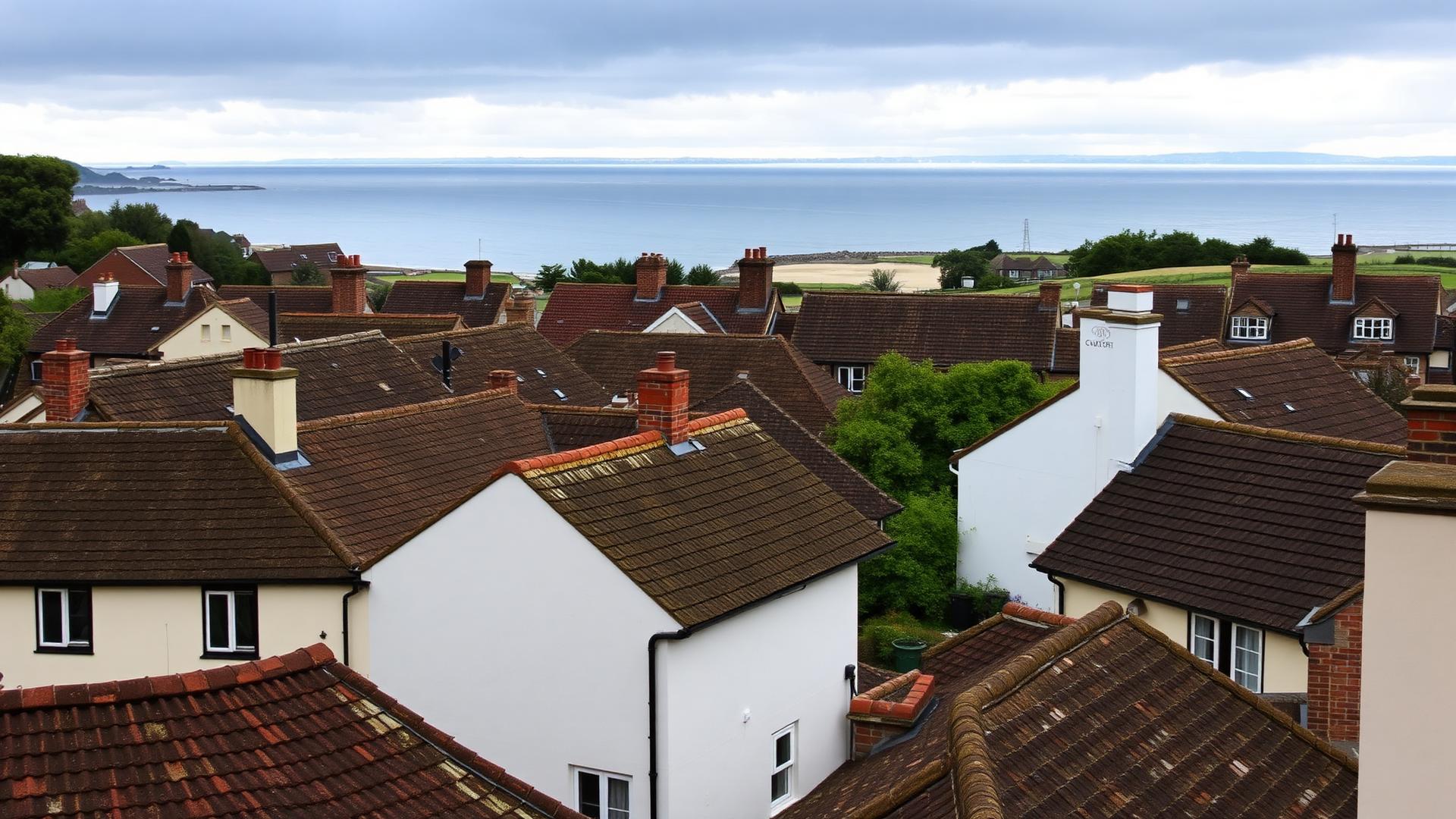
We carry out drone roof surveys across Dorset, Hampshire and Somerset for homeowners, landlords, buyers and managing agents.
What a drone survey can find
Roof defects can be small and difficult to see from the ground — a lifted flashing, a cracked bed of mortar or a slipped tile above a valley. A survey can provide useful close-up evidence of those external areas.
- Slipped, cracked or missing tiles and slates, including single tiles that have dropped out of line
- Failed ridge and hip mortar, loose ridge tiles and open bedding joints
- Split, lifted or short lead flashing at abutments, valleys and around roof windows
- Cracked chimney flaunching, eroded pointing, open joints and damaged pots
- Blocked or sagging gutters, choked valleys and standing debris
- Storm damage — lifted sheets, displaced ridge, impact damage from branches or aerials
- Failed laps, blisters, splits and ponding on flat roof areas
- Heavy moss growth holding water against the covering and washing into the gutters
The parts of a roof you cannot judge from the ground
From the garden you can often see only part of the roof. Ridges, hips, valleys, flashings and chimney heads may be hidden by the pitch, so aerial images can add useful external evidence where safe access is difficult.
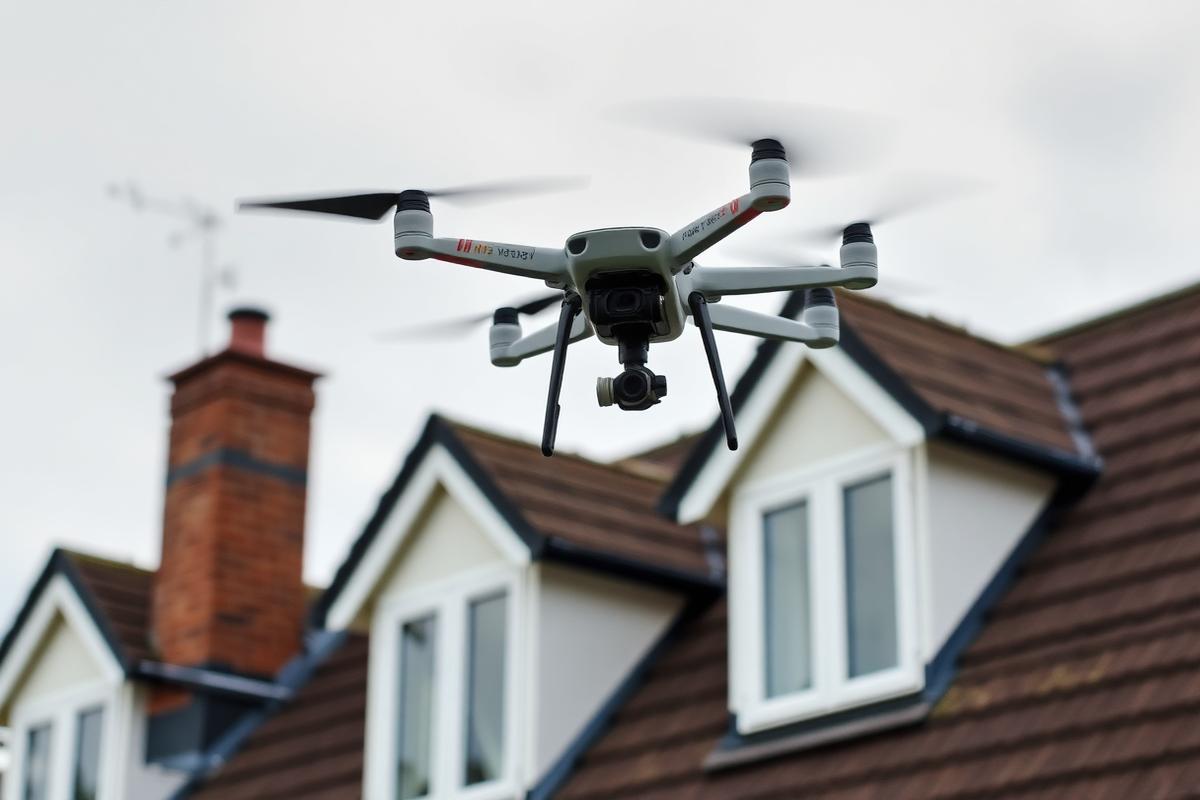
A drone can photograph the surveyed elevations and roof details from useful angles. The images help show what is visible, while a loft or physical inspection is still needed for concealed conditions.
- 1The drone surveys the whole roof from above — nobody goes onto it
- 2Ridge, hips, valleys and flashings photographed in detail
- 3Chimney head, flaunching, pots and back gutter
- 4From the ground you see the lower slope and gutter line — and very little else
What happens when you book a survey
Surveys are usually a single visit and take under an hour on a typical house. There's no scaffolding, no ladders against the gutter and nobody walking across your tiles.
1. Brief
You tell us what's prompted the survey — a leak, a storm, a purchase, or a quote you want checked.
2. Flight
A short flight over each elevation, the ridge, valleys, flashings and chimney — nobody needs to go onto the roof.
3. Imagery
High-resolution stills of the surveyed external areas, with close-ups where something needs a closer look.
4. Findings
A plain-English write-up: what's sound, what needs attention now, and what we can just keep an eye on.
5. Quotation
Only if work's needed, and priced against what the images show rather than a guess.
What you receive afterwards
You get the high-resolution images and a plain-English write-up of what they show: what's sound, what needs attention now, and what can reasonably be left and kept an eye on for a year or two.
Where repair work may be needed, the images help us explain what can be seen and what would need closer inspection. A drone cannot reveal concealed conditions, and if the visible roof looks sound, we'll say that clearly too.
Storm damage and insurance evidence
After a storm it's worth getting dated photographs of the damage before anything's disturbed by a temporary repair. A survey gives you that record.
Whether a particular claim's accepted is down to your insurer and your policy wording, and we can't promise any outcome there. What we can do is document the condition of the roof clearly, so you're not arguing from memory.
Buying, letting and managing property
Before you buy
A homebuyer report will normally note that the roof was only inspected from ground level. A drone survey fills that gap before you commit — and a known roof problem is a lot easier to discuss during a purchase than after it.
Landlords and managing agents
A periodic survey across a portfolio catches slipped tiles and blocked valleys while they're still a small job, and gives you a dated record of condition between tenancies without needing to arrange access to the roof itself.
Checking a quotation
If you've been told a roof needs stripping and re-covering, a survey is a cheap way to see the evidence for yourself before spending five figures on the advice.
What a drone survey will not tell you
A drone works from outside the building. It won't show you the condition of the rafters, the underlay or the insulation, and it can't trace the path water takes once it's inside the roof. Where that matters we combine the flight with a look in the loft.
A drone survey gives us a very clear view of the outside of the roof. If we also need to understand what's happening inside, we can combine it with a loft inspection.
| What you want to know | Drone survey | Also needs |
|---|---|---|
| Outer covering — tiles, slates, ridge, flashings | Photographed in detail from above | No access needed |
| Chimney head, flaunching and pots | Photographed from above and each side | Otherwise needs scaffold or tower |
| Roof timbers, underlay and insulation | Not visible — a drone works outside only | Loft inspection from inside |
| Whether a leak is active right now | Shows likely entry points, not the water path | Internal check, sometimes a water test |
Common questions
A few things homeowners often ask us about drone roof surveys before booking a survey or quote.
Ask us anything